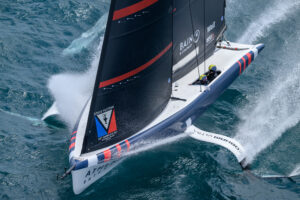
The 38th edition of the America’s Cup introduced an historic innovation: at least one woman will be onboard each of the team’s AC75 yachts, as integral parts of the crew. We discuss the increasing presence and performances of women in sailing with Hannah Mills OBE, Britain’s most decorated female sailing athlete and Athena Pathway Helm and Team Principal. Born in Wales in 1988, she has won two Olympic gold medals in sailing (women’s 470 class), making her the most successful female sailor in Olympic history.
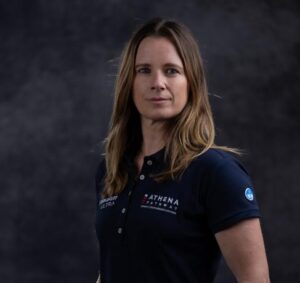 Named twice “Rolex World Sailor of the Year”, Hannah is also a key member of Emirates GBR SailGP as the Team’s Strategist and has been instrumental in developing and promoting the SailGP Women’s Performance Programme, which seeks to increase opportunities for the representation and development of female athletes.
How did you start sailing, at what age and why? Is it true that your parents enrolled you in a sailing course during a holiday to keep you active and that at first you didn’t like it?
It’s true that I started sailing by chance during a summer holiday in the South of England. My parents wanted me to do some sports and we were in a nice bay, but sailing was just an option, not a specific choice. However, since I started, I loved it! The freedom and independence that sailing gives you were a real discovery for me.
Who inspired you or was your mentor in your professional growth in sailing? Did you experience a lack of female role models?
When you start sailing, and I did at 9 years old, you just want to sail and have fun. But things changed when I was 11: I went to an Optimist event and I met Ben Ainslie, who had just come back from the Olympics with a silver medal, and I thought “ok that’s what I want to do! This is my challenge, no matter what the score would be, I want to go there!”. Thinking of female role models, there were several women from Great Britain winning medals at the games, and this example definitely helped me imagine myself as a sailor athlete. I knew what I wanted to do, I had a vision and believed it was possible. But there is a difference between the Olympics, where there is a more balanced presence, and professional or offshore sailing, where there is in fact a gap, with a few incredible women ahead of everyone else, like Ellen MacArthur.
Through the Athena Pathway program, founded by Ben Ainslie and you, you are strongly contributing to making the world of sailing more inclusive: what is working best to foster more women and young people?
I think the most important element is giving women and young people an opportunity to enter and participate in sailing. Our mission is to bring what we’re doing here at the top level of sailing back in the UK. With Athena Pathway we have a really cool hub in Weymouth, where we have a talented squad of WASZP and foiling sailors, and we regularly organise activities. I am convinced that “seeing is believing”: another crucial element is gaining confidence by practicing and starting to imagine yourself as capable of doing it! For example, in our hub we have an AC40 simulator like the one we use there for the America’s Cup and that they can use, because this is crucial to build a connection between the top level sailing and the young sailors who could be there tomorrow. Because in the end, it’s not such a big leap from being a youth sailor in a dinghy and qualifying for the Youth America’s Cup squad. It looks amazing but it’s possible, look at Sam Webb, he is here competing and he is 20. I think the more young people can see this pathway, the more they will be motivated and confident to try. Another important aspect is that – at this level – sailing does not only mean being on the water: here in Cagliari there are about 50 people doing an excellent job “behind the scenes”, looking after every aspect of the boat and the team. Entrepreneurship and curiosity are great skills to begin working with our team, and then find your own pathway and start developing new skills.
How important is technique compared to having a close-knit team?
They are both crucial and what we are trying to do here in Cagliari is work hard to create the best team we can. We’re a bit of a crossover between development and creating the right environment, for new and young people to thrive, and women in particular.
This edition of the America’s Cup brings a historic challenge: on the main boat the AC75 there will be at least one woman on the main team. Formal quotas or disrupting news?
It’s a really powerful moment in the sport right now. I understand the argument of mandatory quotas versus the “best people for the job”. But I think there is no meritocracy if you don’t create the same opportunity at the starting point. So I think it is actually very important to support women breaking through to the top sailing positions, and I cannot wait to see more and more women on board! Looking at the experience of the AC40, where there is a 50-50 team between women and young people, I can say that mixed teams are much more enriching, because you have different points of view and so you can get the whole picture, which in strategic terms can be more performing. Compared to the last edition of the Americas’ Cup – where women had a separate competition – this time it is just so exciting to compete all together, I think it’s more interesting for everyone.
***
Alley Oop’s newsletter
Alley Oop arrives in your inbox every Friday morning with news and stories. To sign up, click here.
If you want to write to or contact Alley Oop’s editorial team, email us at alleyoop@ilsole24ore.com.
