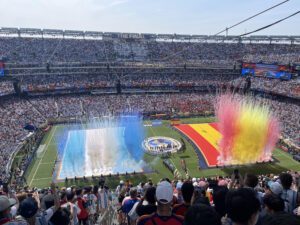
July 19th, 2026—a beautiful, sunny weekend in New York. Together with tens of thousands of fans wearing the jerseys of Spain and Argentina—many with the number 10, Messi, on their backs—I took the New Jersey Transit train to the World Cup Final . Along the way, there was coordinated singing and cheering among the fans—a relatively rare sight in this part of the world.
As the New York New Jersey Stadium emerged from the train window, the singing intensified. Three hours before kickoff, the area outside the stadium was already packed with fan activities, sponsored by corporations. Instead of joining them, I went straight into the still-empty stadium and settled into my seat. I have a ritual.
In Search of Lost Time
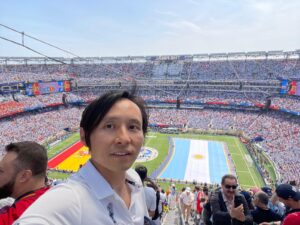 It has been forty years since I watched my first World Cup match. Under the sun, with a gentle breeze, I let my memory roam.
1986 in Mexico: Maradona, Argentina, and West Germany
The first time I watched the World Cup was in 1986, on a TV screen, in China. As China emerged from years of turmoil and opened its eyes, a generation of young people—especially fresh college graduates, my parents among them—longed for the outside world. For those lucky enough to have a television set, the World Cup opened a kaleidoscopic door.
At the time, I was a baby, or a very young child. My only memory of that World Cup was waking up in the middle of the night and going to my parents’ room to watch a game played on a green field of grass. My dad later told me he was watching the final when he suddenly saw me sitting on the carpet next to him, watching as well.
What I witnessed became legend in football history: Maradona leading Argentina against West Germany and eventually winning the World Cup at the Estadio Azteca in Mexico City.
Ten years later, Maradona and his team, Boca Juniors, came to China to play two matches. I was lucky enough to watch him play in person, in Boca’s blue and yellow jersey, in Chengdu. I remember him missing a free kick, then turning to the fans, clasping his hands, and apologizing. FIFA’s Player of the Century (sharing the honor with Pelé) was so humorous, humble, and personable in person. Seeing Maradona play is a memory any football fan would cherish.
1990 in Italy: A Midsummer Night’s Dream
The 1990 World Cup in Italy was pure magic. For generations in China, it is almost impossible to fully convey the profound meaning and imprint of this tournament. The country was changing and opening rapidly and dramatically. More families owned color televisions and could watch live broadcasts of all the games—the first time in China. Many—fans and the simply curious alike—stayed up to watch the matches, an experience that has since become a once-every-four-years ritual in China.
On the pitch, the young Baggio and Schillaci demonstrated why football was called the beautiful game. Off the pitch, it was perhaps the television coverage of the surrounding spectacle—Italy’s cities, history, art, fashion, and life—that fascinated so many. For content not covered on TV, vivid imagination filled in the gaps.
The tournament’s theme song, “Un’estate italiana” (The Italian Summer) , has transcended both the tournament and time itself. Along with it, the collective memory of the Italian World Cup has become a warm, nostalgic hidden garden in the minds of people in China—a memory of a time and a rapidly changing society that many didn’t realize was so dear until it passed by in the blink of an eye, almost without a trace or a farewell.
2026 in New York and New Jersey: Same Game, Different Play
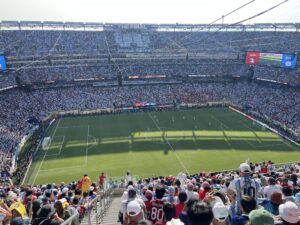 Fast forward to 2026. As I retreated from my memories, the stadium was also filling up. Huge cheers erupted when the players arrived and began warming up. Then finally, the pre-game closing ceremony began. Having watched many games since 1986, in person and on TV, I couldn’t help noticing different things about the game.
Power Play in a Stadium
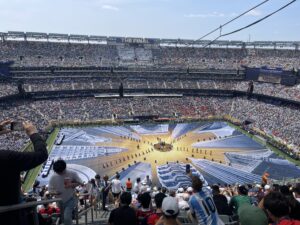 Power is the first word that came to mind—power in different forms, hard and soft, political, cultural, and commercial. The lineup of presidents, royalty, celebrities, and business figures was much larger than the size of the teams: the King and Queen of Spain, the Presidents of the US, Mexico, and Canada, the Prime Minister of Spain, and celebrities from all sectors—sports, entertainment, and media.
The opening ceremony was grand and memorable, with fireworks and performances by top talents including Italian singer Laura Pausini, American singer Nicole Scherzinger, and English singer Robbie Williams—a trio that reminded me of Un’estate italiana in 1990. There was performance by IShowSpeed—the first ever online streamer to perform in a World Cup final—and the US National Anthem sung by Jennifer Hudson. Then Tom Cruise appeared on the pitch to deliver a speech on world unity.
The Game Designed as a Super App
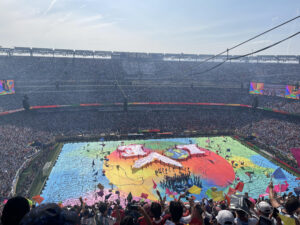 Then came the opening whistle. Messi kicked the ball to start the game. Some fans might say the beginning was slow, but the players’ skills were truly impeccable. I have watched many games in person—football, tennis, basketball, baseball, and sailing—and I quickly noticed what seemed to be a prominent characteristic of this World Cup final: the sheer variety and multitude of elements wrapped into one event. The stadium felt like a giant digital platform—Instagram, TikTok, or Netflix—continuously recommending different types of content, all competing for our attention and time.
From Madonna to Shakira, from Ronaldo to Ronaldinho, from BTS to Bieber
The half-time show—the first in World Cup history—was a spectacle, reminiscent of the Super Bowl in American football. The lineup featured legends from various fields. Madonna first appeared on the big screen, performing a song, joined by two football legends: Brazilian stars Ronaldinho and Ronaldo. Then Shakira performed, together with Africa’s Burna Boy. BTS, the famous South Korean boy band, delivered a performance. Justin Bieber, walked across the pitch with a guitar and sang “Everything Hallelujah.”
Snacks or Superstars
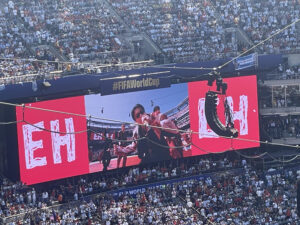 There were so many superstars, and each performance was so short, that the audience in the stadium had to stay laser-focused to keep up. When people went for a hotdog—a New York baseball tradition, I was told when watching a game at Yankee Stadium years ago—they might miss a live performance by several superstars. The half-time experience seemed designed perfect for TV and online viewers at home. I stayed to watch every performance, but many football fans, interestingly, disappeared the entire time to get the famous New York hotdogs.
Labubu and Louis Vuitton
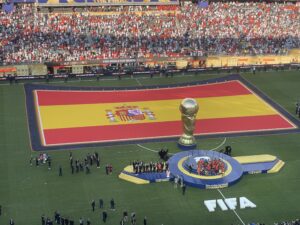
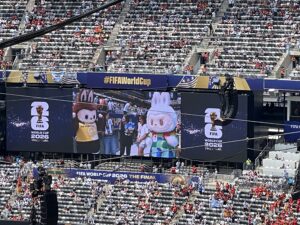 Then Labubu —the little monster character from the designer toy company Pop Mart—appeared on the pitch and on the big screen for an interview. Commerce in general was another prominent, visible theme of this World Cup. Even after the match ended, when the golden FIFA World Cup Trophy was about to be presented to the winning team, Spain, the broadcast emphasized that it was the “Louis Vuitton FIFA World Cup Trophy.”
The Beautiful Game in Changing Times
When the game finally ended, Spain celebrated with the trophy beneath New York’s golden sunset. I found myself thinking of Roberto Baggio’s solitary figure on the pitch after the penalty shootout against Brazil in 1994, also on a hot summer day, also in America. At the World Cup, some things never change. But time always does. The World Cup is a canvas of everything—for every emotion, every memory, and every era.
***
Alley Oop’s newsletter
Alley Oop arrives in your inbox every Friday morning with news and stories. To sign up, click here.
If you want to write to or contact Alley Oop’s editorial team, email us at alleyoop@ilsole24ore.com.
