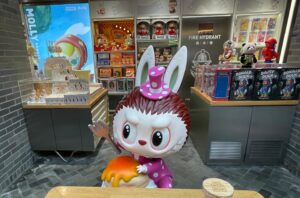
With Halloween around the corner, one creature stands out as this year’s most prominent monster: Labubu.
The fang-bearing, fuzzy-bodied elf with a slightly-sinister grin and mischievous demeanor from the realm of designer toys, has become one of contemporary culture’s most recognizable symbols. This little monster has captivated different audiences around the globe, from everyday consumers, to art collectors, to style icons and celebrities. Madonna, Rihanna, K-pop star Lisa, David Beckham, Apple CEO Tim Cook, and many others, all displaying their Labubus as a fashion accessory on social media.
Beyond its circles of collectors, celebrities, and fans, Labubu has been steadily making its way into the worlds of high fashion and big business, collaborating with luxury houses, inspiring limited-edition streetwear, and even appearing in art galleries. An expanding roster of brands across fashion, art, and consumer culture have joined forces with the little monster, merging their brands with the little monster’s distinctive image. The lineup ranges from LVMH Group’s Parisian bag maker Moynat, to apparel labels Vans, Zara, and Uniqlo, to global brands Coca-Cola and Stanley, to the Louvre Museum.
Labubu is controversial. Some critics dismiss it as an ephemeral consumerist fad, while others celebrate it as timeless art. Divergent views aside, Labubu embodies the playful rebellion of contemporary design, thriving at the crossroads of art, fashion, social media, and pop culture. How did this mischievous little monster achieve such global prominence? And what can businesses, entrepreneurs, designers, and artists learn from its success? In the following, we explore the secrets behind the meteoric rise of Labubu.
Art Born Global
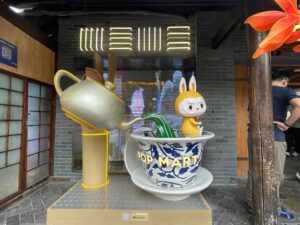 Labubu began its life as a narrative-driven artwork. Its creator, Kasing Lung, was born in Hong Kong and emigrated with his family to the Netherlands in the late 1970s at the age of seven. Confronted with barriers including language, Lung immersed himself in picture books, suggested by a teacher, particularly Nordic myths, and Chinese wuxia, or chivalry, novels. Encouraged by his mother, Lung also embraced film, theater, and musicals and became an avid collector of vinyl records by artists such as Leslie Cheung, Leonard Cohen, Radiohead, and The Beatles.
Falling in love with drawing and pursuing a career in art, Lung published his first illustrated book, My Little Planet, in Chinese, in 2013 in Taiwan. A year later, he released Lizzy Wil Dansen in Belgium, a children’s book created in collaboration with storyteller Brigitte Minne.
In 2015, Lung launched the picture-book series The Monsters, inspired by Nordic mythology and set in a richly imagined universe populated by a variety of whimsical creatures. That same year, Hong Kong-based figurine maker How2Work collaborated with Lung to produce collectible figures based on these characters. Among them, one gained tremendous popularity: Labubu.
Cultural Entrepreneurship
Behind Labubu stood the company Pop Mart, the force that propelled the little monster into the stratosphere. Pop Mart’s own story is no less remarkable than Labubu’s.
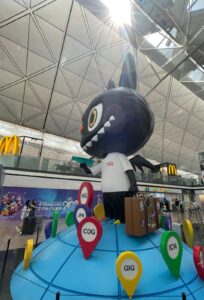 Founded by Wang Ning in 2010, Pop Mart began as a small lifestyle shop in Beijing. Born in the 1980s in Henan, China, Wang studied journalism and communication at university before starting his career in media, focusing on cultural reporting. Unlike traditional entrepreneurs or corporate executives, Wang is more akin to a cultural curator and creative strategist. Driven by his passion for art, design, and culture, he opened Pop Mart with a vision that blended creativity, retail, and storytelling.
After a period of exploration, Wang discovered a growing global community of collectors fascinated by figurines and character-based art. Pop Mart soon pivoted toward the world of designer toys. A major turning point came with Pop Mart’s adoption of the “blind box” model — sealed packages containing randomly selected toys — which added elements of surprise and gamification to each purchase.
While Pop Mart initially operated as a retail platform, Wang Ning recognized the deeper value of original art, design, and intellectual property. In 2016, the company began licensing and developing its own creations, collaborating closely with emerging artists and designers. Among its most successful creators are Kenny Wong, the mind behind Molly; Xiong Miao, the creator of Skullpanda; and Kasing Lung, the artist who gave life to Labubu. Together, they became the architects of Pop Mart’s innovative business model — one built on the twin pillars of expansive retail networks and original, collectible design.
Strategic Design
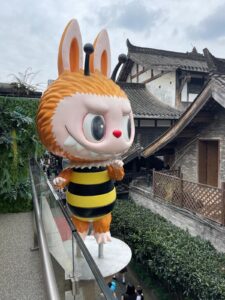 Labubu’s rise is no accident. It is the product of Pop Mart’s multi-year commitment to a carefully orchestrated and deeply strategic approach to design—one that fuses emotional storytelling, visual identity, cultural symbolism, and cross-cultural innovation. Each of Pop Mart’s signature characters, including Labubu, carries a distinct backstory, personality, and emotional texture that resonates with consumers.
Labubu’s design—a mischievous smile, chaotic hair, and wild, gleaming eyes—embodies both innocence and defiance. Within its mythos, the “Labubu tribe” of elves is a female-dominated society, while individual characters span both male and female identities. This balance of strength and vulnerability appeals especially to adult collectors, who see in the little monster a mirror of their own inner contradictions. The emotional layering is deliberate: it transforms Labubu into a vessel of personal meaning and self-expression, enabling fans to form a deep psychological bond with the character.
Over time, Labubu’s design has continued to evolve. Pop Mart has periodically launched seasonal and limited-edition releases, turning toy collecting into an experience defined by scarcity, anticipation, and communal excitement. The company has also perfected three key tactics: collaborations with artists; exhibition-style pop-up stores often integrated into iconic urban architecture; and crossovers with other intellectual properties. Together, these strategies have firmly embedded Labubu within the global cultural zeitgeist. In essence, Labubu stands at the heart of Pop Mart’s meticulously constructed narrative universe—an ecosystem where design fuels desirability, identity, and community.
Worldwide Footprints
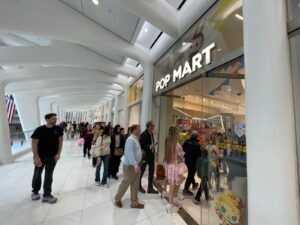 ‘Labubu’s global ascent has been fueled by Pop Mart’s agile and tailored internationalization strategy. The company’s success in China can be attributed to a comprehensive portfolio of initiatives, including the rollout of staffed flagship stores across major cities, the deployment of automated “roboshops,” and the extensive use of digital apps and online platforms—crucial drivers in China’s retail landscape. Pop Mart also skillfully stimulated both repeat purchases and secondary-market demand, transforming collecting into a cultural and social experience. In 2020, Pop Mart went public on the Hong Kong Stock Exchange, signaling its evolution from a niche retailer into a global brand.
The company’s international expansion followed a regionally phased approach. From its first overseas store in Seoul in 2020, Pop Mart extended into markets including the United States, United Kingdom, continental Europe, Australia, and Southeast Asia—building its global footprint through a mix of flagship stores, roboshops, and pop-up concepts, all refined through its success in China. By 2025, international sales had surged, solidifying Pop Mart’s status as a global player. In 2021, nearly all of its revenue originated from mainland China; by 2026, according to research by Bank of America, more than half is projected to come from outside China.
Pop Mart’s dual-engine strategy—domestic dominance paired with an incremental global rollout—has catapulted the company into a cultural and commercial powerhouse, with a market valuation exceeding $45 billion in 2025.
The Kidult Movement
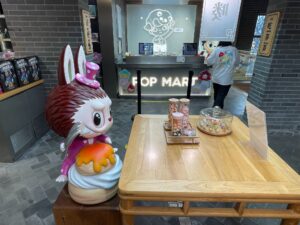 Culturally, Labubu stands at the heart of the so-called kidult movement. The term kidult—a portmanteau of “kid” and “adult”—refers to adults, largely millennials and Gen Z consumers, who embrace childhood aesthetics, activities, and collectibles. Once dismissed as niche or immature, kidult culture has evolved into a mainstream global phenomenon. From designer toys and cartoon merchandise to amusement parks and anime conventions, the movement reflects a yearning to reclaim wonder, creativity, and playfulness in an increasingly fast-paced and stressful world.
As an icon among kidult collectors, Labubu serves as both a symbol of emotional nostalgia and a canvas for artistic expression, identity, and taste. Its popularity exemplifies how kidult culture merges art, design, and commerce—transforming toys into coveted lifestyle artifacts. In many ways, Labubu embodies the psychology of kidult consumers: a longing not for escapism, but for nostalgia, comfort, imagination, and the freedom to defy so-called adult conventions through playful design.
Art or Not
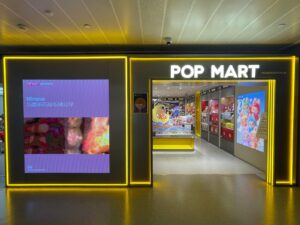 Labubu has become a commercial sensation. But is Labubu art? Opinions differ widely. Many consider it a form of contemporary art. In particular, Labubu and pop art share a common DNA: both draw from popular culture, embrace mass production, and challenge the boundaries between high and low art.
Labubu incorporates familiar visual cues—cute figures and childhood motifs—then reframes them with irony, depth, and psychological resonance. In this sense, it shares similarities with Takashi Murakami’s Superflat works and even Andy Warhol’s Campbell’s Soup Cans.
A key difference, however, lies in intent. Traditional pop art often critiques consumerism from a detached stance, whereas Labubu is fully immersed in and fueled by consumer desire. The line between art and business, as history shows, can be fluid. When increasingly engaged in commerce, Andy Warhol once stated in his diaries:
“Business art is the step that comes after art. I started as a commercial artist, and I want to finish as a business artist”
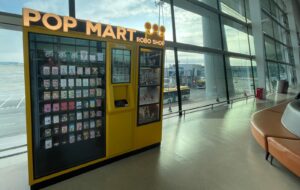 At the intersection of art and business, Labubu can reflect the evolution of pop art into a participatory, collectible ecosystem—one in which fans become co-creators of meaning. In this way, Labubu may represent a post-pop art era where strategic design and emotional branding converge to redefine how audiences engage with art.
Whether or not Labubu qualifies as “art,” the little elf—and the house of Pop Mart—will continue to shape culture. In a recent interview, Pop Mart’s founder Wang Ning articulated the company’s vision and perhaps its future legacy:
“I believe we are a company that deeply respects design. We genuinely believe that design and beauty have a powerful influence“
If design and beauty remain at the heart of Pop Mart’s philosophy, Labubu’s impact may endure far beyond this Halloween.
***
Alley Oop’s newsletter
Alley Oop arrives in your inbox every Friday morning with news and stories. To sign up, click here.
If you want to write to or contact Alley Oop’s editorial team, email us at alleyoop@ilsole24ore.com.
